
The Wrong Tree
Misdirected barking

People who have never fished can have no inkling of the joy of fishing. And those who have never hunted can’t understand the magic of hunting. People who object to hunting and fishing – and they are many – have never been truly hungry.
Our American ancestors hunted and fished to put food on the table. Hunger drove them to it. But they loved the thrill, and the sense of accomplishment of a successful hunt, too. The first man who went hunting at the Jamestown colony in 1607 – probably only a day or two after his ship the Susan Constant anchored out in the James River – could hear his own heart pounding and feel his hands shaking when he pointed his matchlock musket at the first browsing deer that wandered past his hiding place. Buck fever! The joy in his heart, and the hope for a juicy venison steak, were dancing wildly in his head when his firearm roared and he saw the animal leap and then go down in a heap. His hand trembled when he drew his knife and walked up to the dying animal to slit its throat and end its misery. He knew that when he returned to the camp with the carcass of the deer draped over his shoulders, he would be greeted by shouts of joy, would be admired and counted a good man. He would eat well, too, he knew, at least until the venison was gone. There are many satisfactions in hunting; body, mind, and spirit.
Two hundred years after that first hunter at Jamestown came striding back into camp with that deer on his shoulders, his descendants were treeing bear and shooting buffalo out in the wilderness six hundred miles to the west, in Tennessee, Kentucky, and Indiana. Six generations had passed by then, but men still hunted for meat and skins, and for the thrill of it, too.
In time, our pioneer forbears discovered that feeding hogs and cattle with their harvested Indian corn crop multiplied its value. Over the years their herds grew more numerous. Pork chops and roast beef on the table replaced bear steaks. As this was happening, during the first decades of the 1800’s, wild game grew scarcer. Still, men and boys continued the tradition of hunting, partly to replace their monotonous diet of pork and beef with heartier-flavored squirrel or venison or wild turkey, but just as much for the joy of the hunt.
No animal was more a pleasure to pursue than a little black-masked-cute imp-of-a-critter called “raccoon” today, but referred to as “coon” by our pioneer forbears. It had a fine, heavy pelt, which made for a wonderful winter coat, or a warm cap. Furthermore, a good coonskin might bring a few pennies in trade, too, at the store in the nearest town. Raccoons were abundant, because they thrived around the farm and the clearing that had sprung up in the midst of their original forest haunts. Curious and smart, they quickly discovered the delectable, sweet corn patch in the cabin yard. A family of prowling coons could devastate a large garden in a single night. Many a pioneer, on espying the carnage of his sweet corn of an early morning, swore, with narrowing eyes, a blue oath, declaring that Johnny Coon would pay dear for his meal, that very night! On other occasions, his wrath against raccoons was stirred up for other reasons. Sooner or later Mr. Coon invariably discovered the hiding places for the pioneer’s hens’ eggs and knew the lip-smacking pleasure of sucking them dry. Many a pioneer wife emitted a yelp of dismay when she discovered, in her secret hen’s nest, not eggs, but eggshells! Cute as he was, fastidiously washing his little hands in the creek after savoring his meal, Mr. Coon became the creature the pioneer most enjoyed disliking, though with an admiring kind of affection.
Our pioneers respected raccoons for a special reason: they were vicious fighters. Woe to the dog that plunged recklessly into the water to attack a retreating coon. He could easily have an ear bitten off, lose a patch of his scalp, or even drown if the coon was big enough. Many an old, wise hound learned the hard way not to take on a raccoon in the water, the masked creature’s preferred fighting venue. When the younger inexperienced dogs of a pack piled snarling into the stream to attack with wild abandon, old Blue would hang back on the shore, content to be an observer. He had, in modern terms, been there, done that. He sat back and watched the fun, from a safe distance.
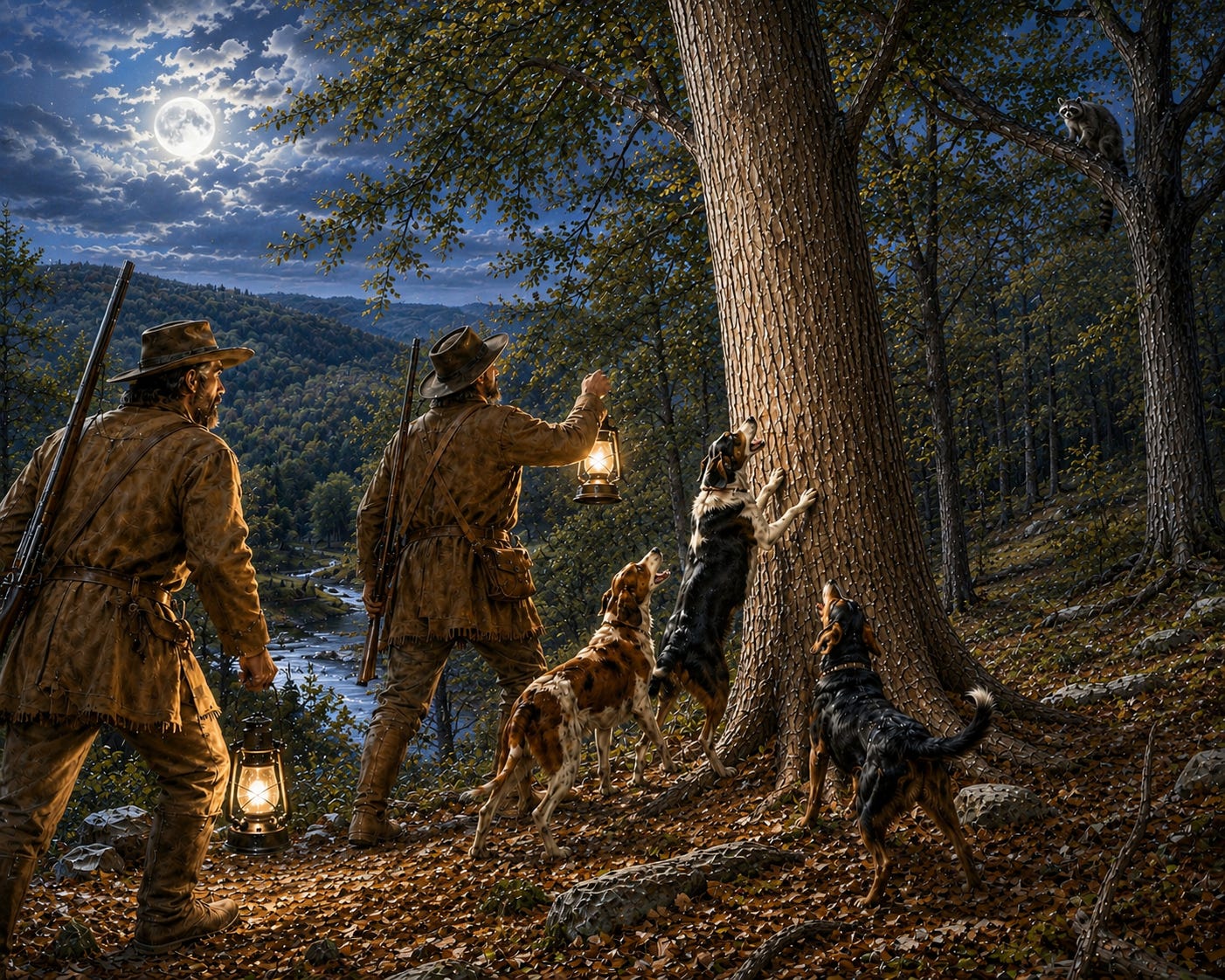
And so, the stage was set for the hunting of the raccoon. The best hunting was when the night came down under heavy hanging clouds and still air, for then the scent of brother coon would hang like a clinging fog, lingering on the woodland path, draped over the rocks of the woodland stream, easy to discover and follow. Two or three experienced dogs were plenty, and always ready. Whining, jumping in happiness, alert in excitement at their night’s coming work, they ran happily before the party of two or three hunters striding toward the bluffs above the river. Each hunter carried a lantern in one hand and a rifle in the crook of the opposite arm. They chatted happily but in soft tones, suppressing their excitement. Before long, one of the dogs up ahead would bawl and the spine-tingling sound would echo off the darkened hill, washing over the hunters, who stopped and listened eagerly. A moment later, another of the dogs would join with a higher-pitched call, and finally, older, slower old Blue would join the chorus with his deep, resounding bellow. It raised thrilled hackles on the necks of the hunters, though they had heard it a hundred times before.
In the next minutes, the music of the excited dogs receded as they hurried sniffing and running on the trail of the ever-warmer scent of the raccoon, which coursed toward the waters of the nearest stream. The hunters, listening carefully at the receding cries of the dogs, thrashed through the woods and the brush, getting whipped by branches and stumbling over stumps and roots. Now they would hurry toward the sound of the pack, now pause to listen and adjust their bearing, then rush onward in their new direction while the howls of the hounds echoed magically through the dark, dripping woods. Aware of the danger behind it now, the raccoon would double on its tracks, leap on and run along a downed tree bole, jump into a streamlet and wade for many yards, all to throw the dogs off its scent. Sometimes it would succeed, and the pack would run excitedly back and forth, confused, yelping and whining in disappointment and concern. Sometimes they lost the track altogether, but more commonly they would rediscover it and eventually drive the raccoon up a big tree, somewhere high on the bluff above the creek. The hunters, hundreds of yards back, would at once know that the quarry had gone up a tree, for the dogs would bark “treed,” a call of a different pitch and sound. Arriving at the lofty tree where the dogs were leaping and jumping up the trunk, barking and howling in wild excitement, the huffing and puffing hunters would strain their eyes upward for a glimpse of the treed coon, holding up their lanterns in hopes of spotting the glint of the quarry’s eyes. The whooping of the dogs, the breathlessness of the hunters’ effort, the dark of the night and the thrill of the chase were exciting beyond easy description. It was intoxicating, like fine whiskey.
More than once, the wily raccoon, apprehensive or annoyed at the howling dogs far down below his perch in an ancient tree, would tightrope out along an upper branch and leap daringly to the branch of an adjacent tree. There it would scramble to the main trunk and hide in a gnarled branch or against them trunk. Mr. Raccoon’s secret escape happened unbeknownst to the baying dogs, who persisted in trying to clamber up the vertical trunk of the tree first climbed by their quarry. Their frustrated masters, the very Nimrods, arriving at last, and not seeing the flash of the eyes of their prey in their lantern lights despite much trying and searching, stood scratching their heads. Eventually they gave a kick in the direction of the dogs, scolded them for their over-eagerness at following a false trail, and gave up and set off in search of a less wily coon.
Thanks to the agility and cleverness of their quarry, the dogs were, the hunters grumbled, barking up the wrong tree!