
The Second Law
And stone walls

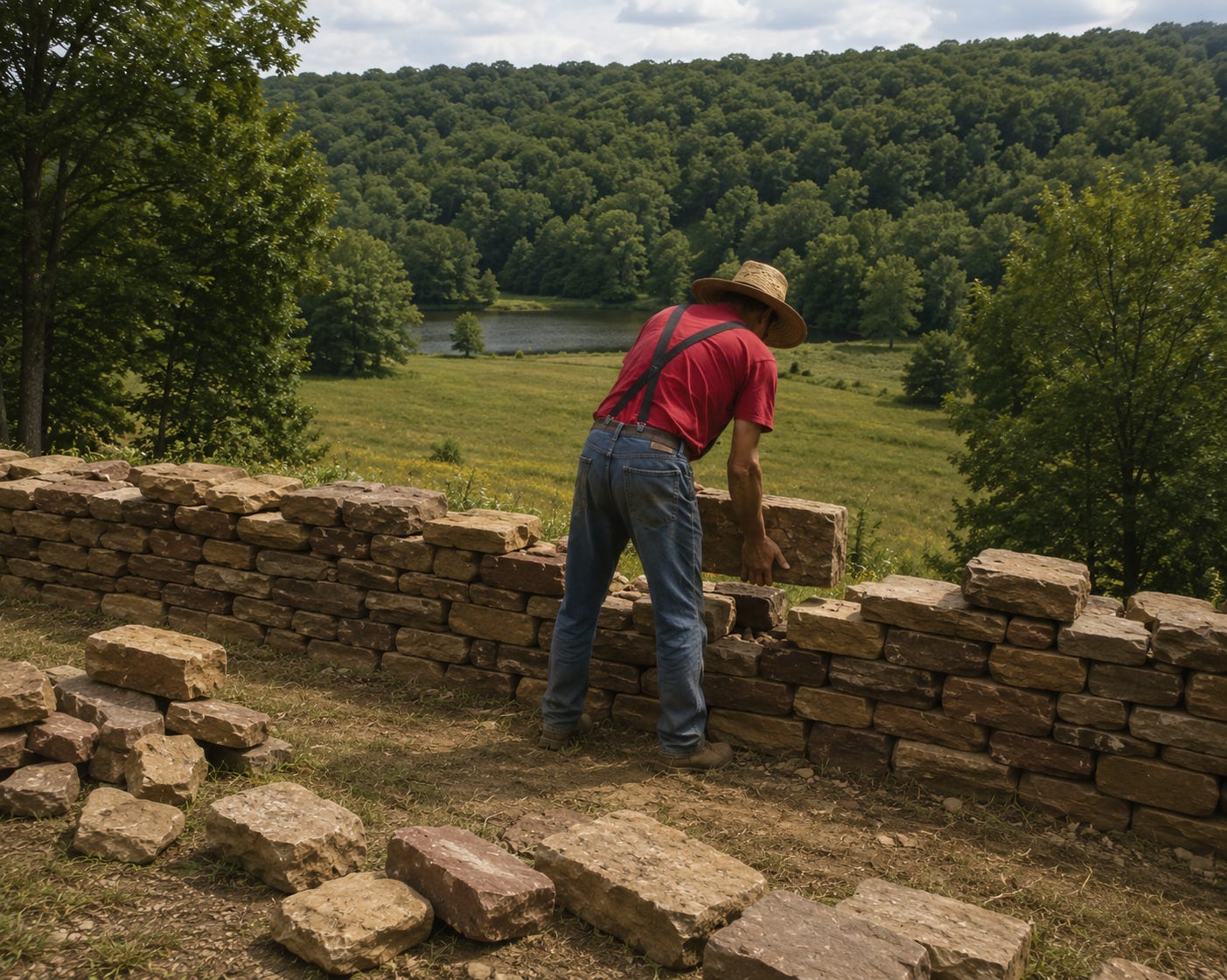
I am building a stone wall.
At least that is what I tell myself when I survey the sandstone blocks stacked near the edge of the meadow below our house at Faraway Farm. In truth, the wall is building me — or maybe undoing me. My fingers are sore despite my gloves, and occasionally smashed. Blood-sucking ticks lurking in the nearby weeds creep on me and attach, hoping I won’t notice. My lower back aches when I bend a certain way. There are annoying moments, as when a stone that looked perfectly flat in the wheelbarrow suddenly reveals its unevenness and unsuitability when I try to set it in place. The dang thing doesn’t fit like it should. Some of them wobble. Some lean and threaten to be unstable. Some simply refuse to accept their fate of becoming wall stones.
Gravity, I have learned, is friend and enemy.
Yet I persist.
I love stone walls, especially those built with native rock I bring in from the ravines and place by hand, each stone fitted and held in position not by mortar but by gravity’s relentless grip.
A good stone wall looks natural, like a sandstone outcropping, fitting in as if the hillside itself wanted it there all along.
This reflection on my wall begins with science and ends, I think, with philosophy.
Science enriches us by waking us up to realities we never knew were there. It rouses us from our sleep. Knowledge and understanding are the real riches.
One of the greatest awareness-awakening discoveries of physics is the Second Law of Thermodynamics. It says that in an isolated system entropy never decreases; it either remains constant or increases.
Entropy is sometimes loosely described as disorderness, randomness, or decay, though physicists have in mind something more precise. They mean the tendency of matter and energy to spread into less organized, more probable, less complicated arrangements. The Germans state it elegantly in their precise language:
Die Entropie strebt einem Maximum zu. Entropy strives towards a maximum.
Try to understand this, nurse it like a mother. Entropy does not increase everywhere at every moment. Local pockets of increased order exist. But they do so only temporarily, and always by borrowing energy and material from somewhere else.
Join me in a thought experiment. Imagine an 1880s red-brick Italianate mansion with tall windows, a tower, and a crowning cupola. Enormous labor, skill, and energy went into scouting out and arranging brick, timber, glass, and iron into that elegant form. Yet if you leave the mansion untended long enough the roof eventually leaks, frost opens cracks in the mortar, vines creep upward, gravity makes demands on the supporting beams, and one day the whole thing collapses into rubble and dust.
The complex, highly organized arrangement fails.
Entropy has increased.
But ruined mansions are easy examples. There’ a more difficult one.
Life, living things, present a deeper puzzle.
Think of a towering redwood in California or a black beetle resting on a rock in the Namib Desert. Each gathers energy and materials from the surrounding world and fashions something astonishingly ordered: itself. In other words, living systems collect molecules from air, water, and earth and — powered by sunlight or energy-rich food — create tissues, organs, memory, movement, awareness.
At first glance, living systems appear to contradict the Second Law.
But living things are not isolated systems. They are always part of a greater whole.
The tree grows by catching concentrated solar energy and carbon dioxide and transforming them into wood, roots, bark, and leaves. Yet while doing that it releases degraded energy as heat into the surrounding world. The local increase in order, in non-randomness, comes at the cost of greater disorder around it. Life may delay the forward march of entropy in one place but accelerates it in an adjacent one.
Eventually, the inevitable happens.
The redwood falls. Fungi soften its wood. Beetles tunnel through it. Wood crumbles to dust. Rain and bacteria continue the work. What stood for centuries becomes soil again.
Entropy has increased.
The beetle resting on the Namibian desert stone is gobbled down by a seagull and the meal is transformed into flight, feather, warmth, and droppings splattering on some distant shore.
The complex arrangement that was a beetle disintegrates.
Patient always, entropy resumes its increase.
Which brings me back to my stone wall.
A stone wall may seem, in its own humble way, an argument against entropy.
The hillside prefers disorder. Gravity prefers collapse. Roots pry stones apart. Frost lifts and shoves. Water carries things downhill. Moss, lichens, time, neglect — all quietly campaign to surrender to entropy.
For a while, a human can resist, can bar the door to entropy.
Building a wall, I bend over a promising stone, study its shape and balance, reject it maybe, then turn to another, mutter under my breath, scratch my head, and carefully choose order — a portion of a drystone wall arises — on a reluctant world. I pay for this new arrangement with sweat, strained muscles, smashed fingers, and time — always time.
The wall will not last forever. I know that. Should I not build it?
Its impermanence bothered me once. Why build what will someday fail, fall away?
Wait! That is the wrong question.
The philosopher Martin Hägglund argues that the things we value deeply matter precisely because they are finite. If we lived forever, time would lose urgency. There would always be time to do anything. No hurry. Love would lose some of its sweetness if those we love would be there forever. There would be no need to worry about them. Meaning itself would thin out. We care because loss is possible.
A wall that could never crumble would not really be precious or lovely. Enjoy it while we can because it might be gone tomorrow.
Nor a marriage. For eternity.
Nor a dog. For eternity,
Nor a life. Forever.
The Second Law guarantees that all non-random arrangements of matter and energy eventually come undone. Nothing assembled stays assembled forever. Not Italianare towers. Not stone walls. Not redwood trees. Not civilizations. Not us. Not me. Not those I love. Not you.
Yet strangely, impermanence is not cause for despair.
Quite the opposite.
The fact that things do not last forever is exactly why they deserve our care.
Cherish them.
And so I keep building my wall.
This I know: Someday frost and growing roots and gravity will undo what I am building. Five hundred years from now some future wanderer may come across a tumbledown line of stones along the hillside and wonder who bothered to place them there. Or wonder, maybe, if nature had put them there by chance.
I hope that person understands.
Or at least pauses for a moment before walking on.
And wonders…
Is the wall for protection to keep someone out or is it to keep you in?