
Every Breath You Take
What your argon has been through!

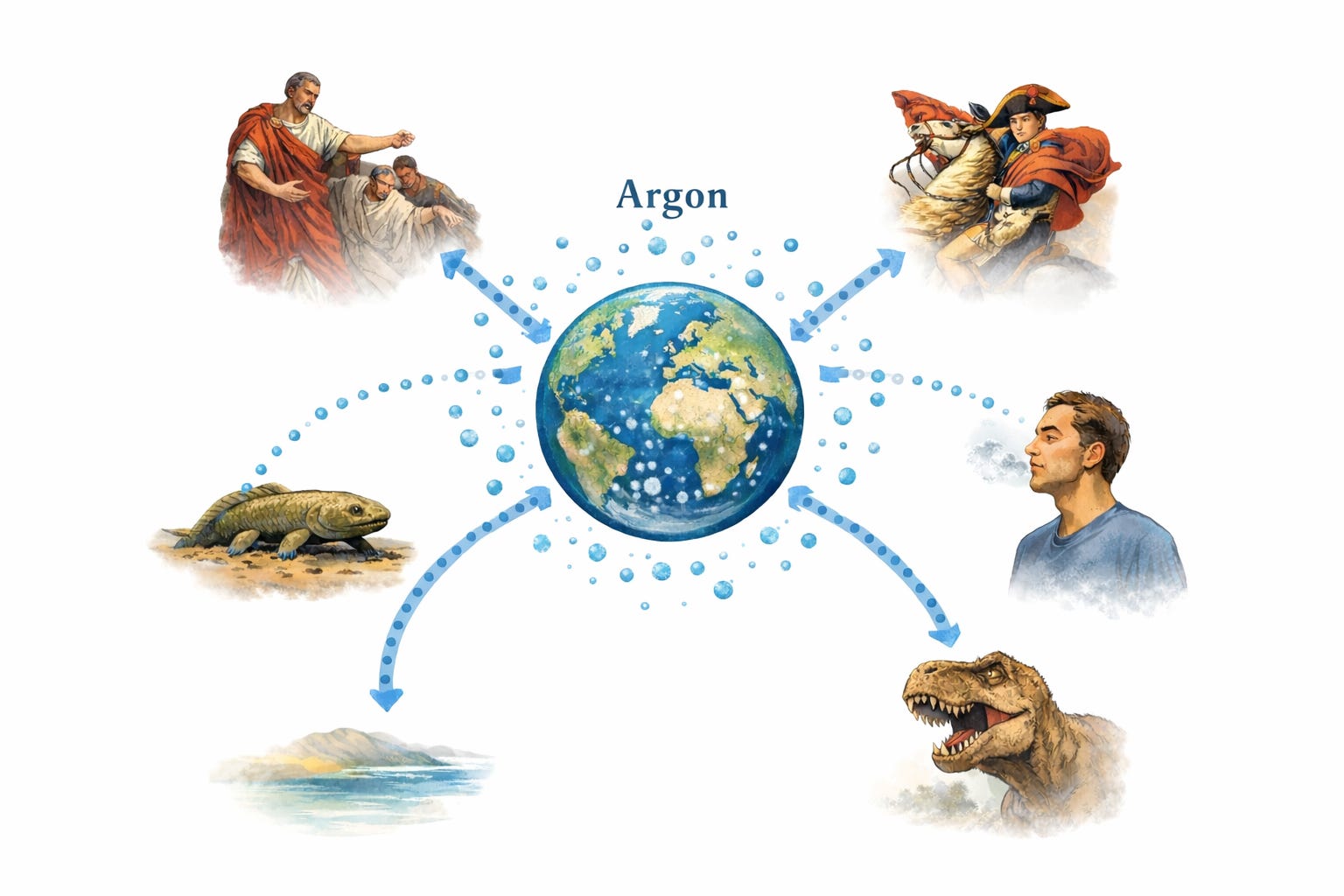
The world is full of hidden wonders. Most of us pass by them without noticing. Here is one.
The next breath you take will contain molecules that were in Julius Caesar’s lungs when he was stabbed to death.
Not metaphorically. Literally.
That claim sounds like the kind of thing people say at cocktail parties without really knowing whether it’s true.
It is true. Here is why.
A single breath is roughly half a liter of air. That half liter contains twelve sextillion molecules more or less— a number so large it defeats ordinary imagination. Think of it this way: there are more molecules in one breath than there are grains of sand on all the earth’s beaches. That extraordinary abundance is the key to everything that follows.
When Caesar exhaled his last breath on the steps of the Senate in 44 BC, those molecules began dispersing into the atmosphere. Within a few years, atmospheric mixing had distributed them throughout the troposphere, reaching every ocean, every continent, and every cubic foot of air on Earth. By the time his successor Augustus had taken power in Rome, Caesar’s last breath already belonged to the world.
The same is true of Napoleon’s triumphant deep breath at Austerlitz in 1805, when he recognized he had won the battle. It’s true, too, of the last breath of the last Tyrannosaurus rex, 66 million years ago, on whatever unlucky afternoon its end came.
Which molecules, specifically? Here, the chemistry becomes beautiful. Most atmospheric molecules — oxygen, carbon dioxide, water vapor — get captured in chemical reactions, taken up by minerals, and cycled through living things. You cannot easily trace them. But argon is different. Argon is a noble gas, chemically inert, and forms no bonds. It cycles through the atmosphere unchanged, endlessly, leaving no chemical history — only the mathematical certainty that it has been everywhere and through everything.
Your next breath will contain, on average, a few argon atoms from Caesar’s last. The same for Napoleon’s victory breath at Austerlitz and from the final exhalation of the last Tyrannosaurus. If you want to follow the thread all the way back to the first lungfish that hauled itself onto land 375 million years ago and breathed air for the first time in vertebrate history, count that too.
Argon keeps no diary. But the numbers do.
Curiously, reading this on my phone, I checked interrupted to look at a message. Returning, I saw an ad for air purifiers. Coincidence?