
Cincinnatus
Who were you, where are you?

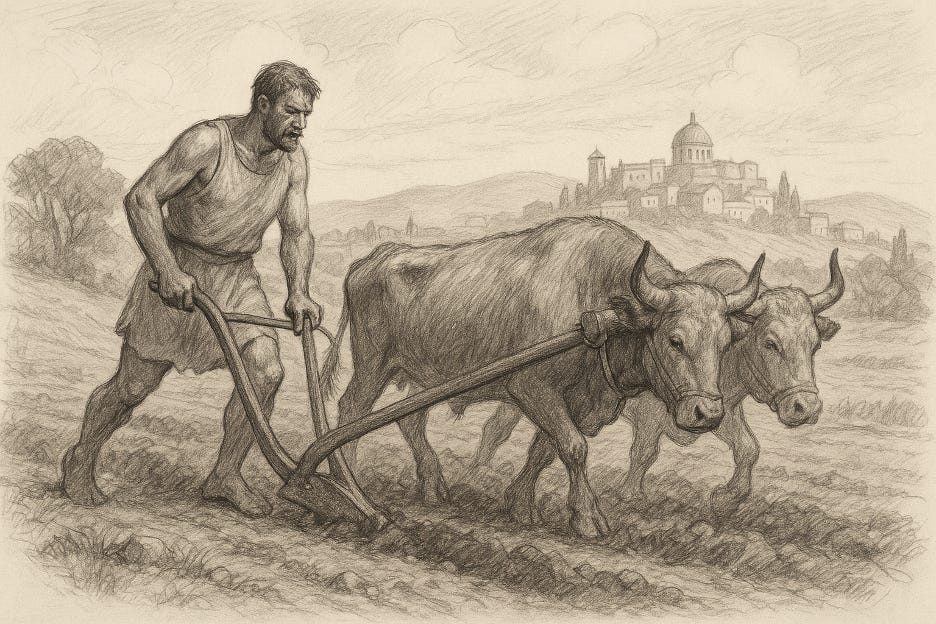
Imagine a man, dusty and sweat-stained, plowing, guiding a yoke of oxen across his modest farm. He’s just an ordinary farmer, right? Not at all. Because this man, toiling in the fields of ancient Rome 2,500 years ago, was about to be granted absolute power to save his nation from annihilation, but after a brilliant success as dictator, in an act that would astonish future generations, he gave all that power away and returned to work his farm.
Just now, reader, you are on the western bank of the Tiber River, across from the still youthful city of Rome. It is 458 years before Christ’s birth. You scan the landscape around you. On the horizon, you see on the rising hills to the east the white buildings of the growing city. In the near distance, you watch a farmer at his work. His plain, sleeveless, linen tunic is sweat-stained as he strides along behind his lumbering, plow-pulling team of oxen. It is clumsy work, and he staggers often as he tries to keep the clumsy plow in the resisting earth. The man looks common enough. He is muscled and strongly built and looks all the world like an ordinary farmer.
You would stare at me in disbelief if I told you the man’s name would be on men’s lips more than two thousand years in the future, a model for all. Fact is, he will be revered, held in awe, at least by those remaining few of the twentieth century who still revere men of character.
“One acre down, four to go,” the plowman thinks to himself, “then I can start planting.” Though poor by the standards of his class, the farmer is nevertheless a Patrician, respected by all, not only by his ruling class, but also by Plebeians of the lower order. The Plebeians, including farmers, tradesmen, shopkeepers, laborers, and soldiers, were aware of this farmer’s family’s glorious past and respected it, even though they enjoyed fewer rights and privileges than did he and other Patricians. Plebeians made up the overwhelming bulk of the early Romans. They cared for their Roman state, grew its crops, handled its shops and daily affairs, but also were willing to fight and even die for it.
As the plowman turns his oxen to leave the field, he stops when he catches a glimpse of a toga-clad official striding towards him across the plowed field. The man, obviously in a hurry, is waving a scroll held high. Nearing the plowman, he calls:
“Lucius Quinctius Cincinnatus, hear me!”
He recognized Cincinnatus, having served under him when Cincinnatus was Consul some years back.
Not rich by the standards of his class, farmer Cincinnatus owned a small parcel of good farmland. More importantly, though, his ancestors were of the noble Patrician class, men and women of virtue and responsibility. Patricians led the Roman society in all political and religious matters. Though not wealthy, Cincinnatus himself was proud to be of an ancient gens, an extended family, a fact more important than wealth in those days. For Patricians, duty, honor, and community were far more important than money or land. Their highest praise went to those who gave unselfish service to the community. Cincinnatus’ farm is indeed small, a mere four acres. It was once part of a large estate owned by his noble family, but hard times came, and they were forced to sell most of it.
The messenger stops, panting. “Greetings from the Senate! I bring a profoundly important message. Hear me!”
He goes on: “Rome calls on you in its time of need, Lucius Quinctius Cincinnatus. Our army, led by Consul Minucius, has been trapped by the Aequi army on Mount Algidus. Our forces are besieged and cannot hold out much longer. If those Aequi, who are hostile to Rome, defeat Minucius, they will overwhelm our great city, looting and pillaging. They will kill our leaders, take our women, and enslave our children. The Senate begs you to raise a new force and rescue our besieged army—indeed, save our city of Rome. They gladly grant you dictatorial powers while pleading for your help. Please do anything you can to save us! Power is yours. You will be the Supreme Commander of the military. You can declare laws without Senate approval. You will stand above all other officials and law-making bodies, and if you wish, overrule any of their acts. You, sire, if you accept, will wield absolute power.”
Recognizing that the emergency was dire, Cincinnatus hurried home, leaving his oxen for his servant to attend to. He called to his wife, Racilia, to bring him his senatorial toga. Donning it symbolized his acceptance of the dictatorship.
He moved swiftly. That same day, he crossed the Tiber River in a boat supplied by the Senate. Led by lictors, he hurried into Rome, where his sons and numerous senators welcomed him.
Aware that urgent action was needed, his first official action was to summon all able-bodied men to assemble at the Field of Mars at sunset. He commanded them to bring their arms and rations for a campaign of several days, and required each was also to carry a bundle of stakes called sudes.
As darkness fell, his hastily assembled little army marched off for Mount Algidus. Reaching the rear of the Aequi’s lines under cover of darkness, using the sudes, his little army erected a barrier that blocked the enemy's escape. And so the Aequi suddenly found itself blocked on one side by the original force of Consul Minucius and on the other side by the newly erected sudes barrier behind which stood Cincinnatus’ forces. In the ensuing battle, the Aequi army collapsed and surrendered.
After the victory, Dictator Cincinnatus still moved swiftly. He distributed the spoils gathered from the enemy camp to his victorious little army. Minucius’ force, which had been outmaneuvered and besieged by the Aequi, got nothing of this, for they got only disdain from their rescuers. Most of the Aequi soldiers were granted clemency and sent home, newly aware of Rome's power. Their leaders were made prisoners and, in chains, forced to pass under a symbolic yoke formed by three Roman spears, signifying their defeat and humiliation.
Cincinnatus and his force returned to Rome, where they marched in a triumphal parade. The chiefs of the Aequi, in fetters, preceded their captor Cincinnatus. The Senate voted the victorious general a formal triumph, the highest honor they could bestow. Minucius was stripped of his consulship.
Cincinnatus now stood at the pinnacle of Rome’s elite.
Yet after 16 days as dictator, in the moment of his glory and at the height of his power, and with a victorious army ready to follow him anywhere, Cincinnatus resigned his dictatorship and returned to his farm. He might have remained dictator, could have elvated himself above all other Romans, and amassed wealth beyond imagination. But he chose not to.
Just a little more than two weeks after leaving his plow and oxen, he went back to them, having fulfilled his duty to his country and his people. He didn’t need wealth or power. He needed only that which he got, the honor of having done his duty for his people and his country.
Almost all current politicians today would—if asked—mock Cincinnatus as a fool. For many today, perhaps most, politics is a pathway to power and wealth. Some are beguiled because it offers a platform on which they can stand and bask in a spotlight that shines on them. Cincinnatus, by contrast, was content to be an ordinary citizen and a working farmer, preferred it in fact. He had no need of wealth, power, or glory.
Few American political leaders can say as much. The closest to the Cincinnatian ideal in American history is George Washington, the farmer-turned-military commander who saved his nation from King George III and led it as President during its formative years. But Washington gladly returned to farming when he was no longer needed to lead the new nation. He left with tears in his eyes, tears of relief and happiness at returning to his farm, Mount Vernon.
Since then, few Americans have come close to the ideal. One is George C. Marshall, who led the United States through World War II and created the Marshall Plan that helped Europe back on its feet after the great conflagration of World War II. Another is Dwight Eisenhower, the General who led the Allied forces into Europe and brought Fascism to its defeated end. He reluctantly agreed to serve two terms as President in the 1950s before retiring to his farm at Gettysburg.
If there is a lesson in all this, it is that great leaders are most likely to emerge during a challenging time, especially one in which there are threats of looming national oblivion. This is exactly what we face today with a convicted felon, an ignorant, uninformed dilettante President running the country. The worst type of flattering sycophants surrounds the man, who is aided in his destruction of our democracy by an enabling Supreme Court and a spineless, fearful Congress afraid to vote against him and evoke his ire.
Cincinnatus's legacy isn't just about ancient heroism; it's a timeless challenge. In an age of endless ambition and political self-interest, his story reminds us of what true civic virtue can be: a selfless devotion to duty, where the reward is the safety and well-being of the community, not personal power, wealth or glory.
These are the days of no heroes. Might there be a Washington out there somewhere, even a Marshall or Eisenhower?
Time, which is growing short, will tell.
Great
Fantastic essay, Larry. You are a super historian. This message is so timely. Who will it be? Pete?