
bob bob WHITE!
A sequel

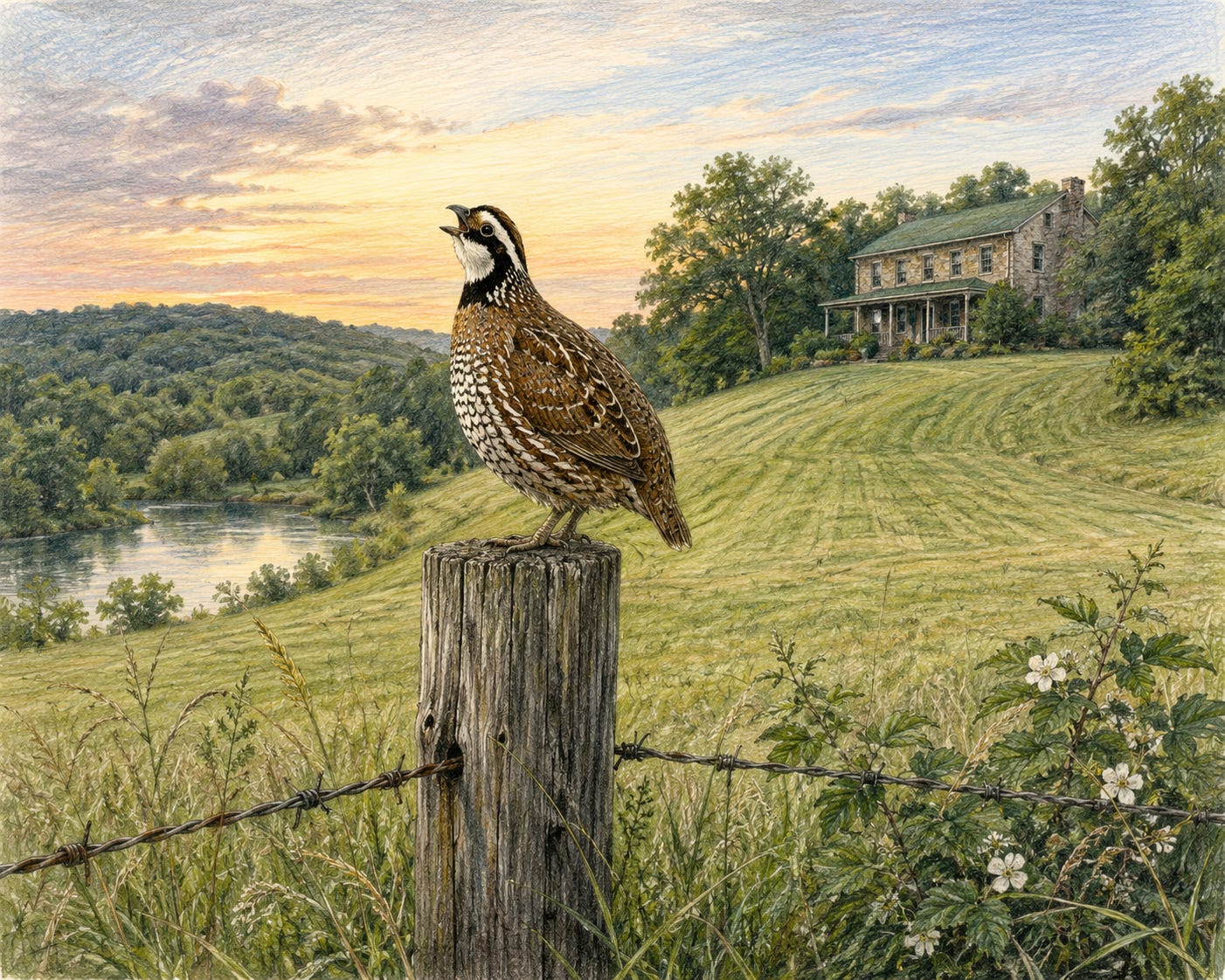
Living at Faraway Farm in the unglaciated hills of southern Indiana has taught us something city life rarely did: if you sit quietly long enough, the wild world begins to speak to you.
One summer we listened for a bird that called and never got an answer.
But first, the place.
Living here at Faraway Farm in the wooded hills of southern Indiana has advantages we never experienced when we lived in cities like Lafayette, Indiana, or Konstanz, Germany.
Sitting quietly on our front porch a year or two ago, we watched a proud mama wild turkey march stately across the lawn that slopes toward our little lake below the house. She could not have been half a football field from us. Susie and I sat perfectly still in our porch swing, anxious not to disturb her family.
As she marched eastward she was followed by a line of twelve one-third-grown chicks, one behind another, in perfect order. Bringing up the rear was another mama turkey, making sure there were no stragglers.
We laughed silently. The scene reminded us of a pair of elementary school teachers shepherding a first-grade class from the school bus to a museum.
Another time, another year, we watched thirteen full-grown tom turkeys—adult males, bearded and proud—march one after another across the meadow in a perfect straight line.
We sit outside a lot, listening and watching. In the evenings now, if we are lucky, we hear the haunting call of the whip-poor-will from the woods far to the east. Sometimes, if luck doubles itself, another answers from still farther away to the north.
What are they saying to one another, these whip-poor-wills calling through the darkness?
I wrote another time about a different bird, one whose coming touched our hearts and whose disappearance left them unexpectedly heavy. The eastern bobwhite quail—named for its lovely call.
I share that earlier post here for readers who were not subscribers when I first published it. But I also share it because there is now an update—a small thing perhaps, but one that feels like a promise of hope.
First, the original post.
Posted June 30, 2024
We are a mile northeast of Leopold, Indiana, at Faraway Farm. It is early summer of 2023 and early evening. The sun has gone down, but the western sky still glows.
Susie and I sit on our patio overlooking the mown hillside that falls away below us. Beyond lies our two-acre lake. Farther north rise cornfields and then wooded hills that merge into the national forest.
We sip wine made from grapes grown in Puglia, down in the heel of Italy’s boot, reminiscing about wheatfields and olive groves we once saw there. We remember Alberobello too, with its remarkable trulli—whitewashed stone houses with limestone roofs built without mortar, improbable and somehow timeless.
Then suddenly we stop.
Both of us turn our heads toward the northwest and cock our ears.
From the distance comes a sound we have known since childhood.
Calling.
“bob WHITE!”
A minute passes.
Then again:
“bob bob WHITE!”
And then once more:
“bob WHITE!”
The unmistakable whistle of the eastern bobwhite quail.
That lovely sound—about as close to pastoral music as one hears anywhere—means something important in the life of quail.
Sometimes it is a young male claiming territory while hoping to attract a mate. Other times it is simply one bird reaching out to others of its covey, staying in touch, not becoming separated. Quail long ago discovered there is safety in numbers.
Hunters understand this well. A covey suddenly exploding into flight can startle even an experienced hunter. Birds burst upward with such thunderous force and scatter in several directions so quickly that predator and prey alike are momentarily confused.
At night, quail even sleep defensively, huddled in a circle with heads facing outward, alert for foxes, snakes, or other dangers.
The bobwhite’s call helps hold that fragile little society together.
As Susie and I sat talking about Italy and wine and old memories, there it was again through the growing shadows:
“bob WHITE” …
“bob bob WHITE.”
Almost at once we realized something that made us strangely quiet.
We had been listening all summer long to one solitary bird.
No answering call had ever come back.
All summer long.
He—if it was a he—never called in a mate. She—if it was a she—never heard another quail answer from a covey because there was no covey.
Only silence answering back.
A wistful sadness settled over us at the thought of that lonely creature calling day after day into emptiness.
Life can be cruel sometimes.
Not just to people.
Late that August we heard it no more.
Just silence.
Maybe a bobcat got it. Or a fox.
That’s life, I suppose.
Or death.
Sometimes we call out for another, and no answer comes back.
We listened all through the spring and summer of 2025.
Nothing.
No bobwhite quail calling.
Another year passed.
And now we stand on the cusp of summer once again, in 2026, after spring’s colorrul procession: first the red maples, then dogwood white and redbud pink, followed by the yellow blossoms of tulip poplar. Now, passing through blackberry winter, the woods edge shows white again.
And then yesterday morning, as Nellie and I walked out to stretch our legs, there it came:
“Bob Bob WHITE!”
Half a minute later:
“Bob Bob WHITE!”
A small thing perhaps. Just a whistle drifting through wooded hills.
But after silence, hope sometimes enters quietly.
Perhaps somewhere out there another quail still lives and listens.
Susie and I will be listening too.
I remember them in the thickets of my grandpa’s farm growing up. I just realized my kids have never been startled by a covey flushing in front of them. They’ve only heard me talk about it.