
A Fold in Time
In passing

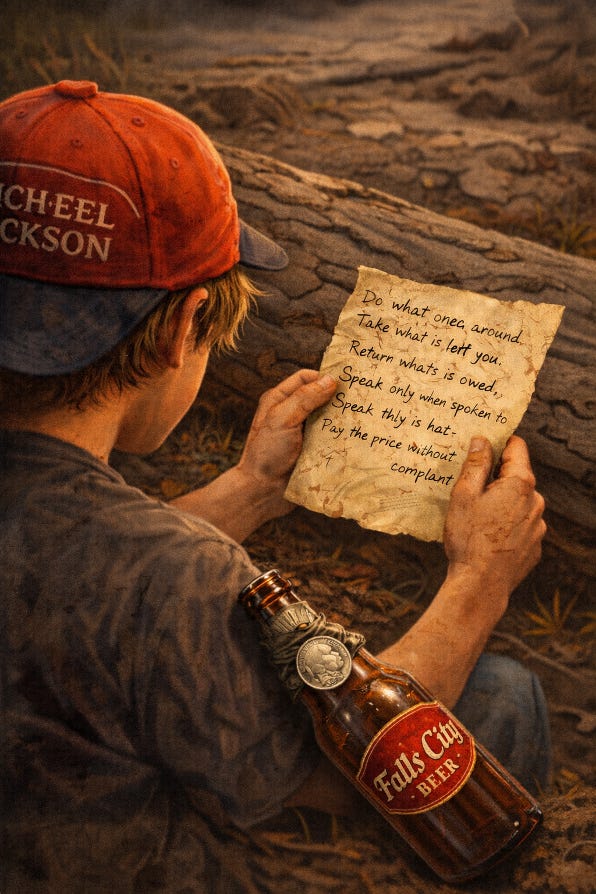
Time, with which you and I have been companions since our fat-cheeked childhood, is the oldest of our friends but the one we understand least. Few people know that just as folding a paper can bring distant points on its surface close to one another, so time sometimes folds on itself.
I tell here the story of a young man who does a wrong, knows what he ought to do to make it right, intends to, but never gathers up the courage to do it. His shortcoming lives on, indefinitely … until time folds upon itself … and the wrong is finally made right.
A sandy-haired, slender 13-year-old named Tom walks toward the Grove at the north edge of the coal-mining town of Linton, Indiana. The Grove is a public youth recreation area named for its tall, ancient trees. Something off the path catches the boy’s eye. He halts. It’s a newly fallen white oak. It was standing tall yesterday. Rubbing the sparse whiskers on his chin, he wonders why the tree went down. He pulls off his Michael Jackson baseball cap and scratches his head. Hmmmm … probably lightning from last night’s storm. It must have hit the standing tree like an artillery round. A jagged line of white running down the prostrate trunk traces the zigzag path the electric fire took. Probably a gust of wind then pushed the thick-as-a-fat-man behemoth over. It came down with a scream of tearing wood and a thunderous, ground-shaking thump.
When Tom resumed his walk, something odd on the downed tree trunk caught his eye and kept him from continuing. A hole in the trunk—it would have been six or seven feet above the ground in the standing tree—caught his eye. It was several inches across and equally deep, a scar where a large branch had once been, since fallen and rotted away.
Kneeling for a closer look, his eye catches on something mostly hidden in the hole. It glints dully and is almost covered by wood debris and mold, a brown beer bottle. Pulling it out and shaking off some of the stuff sticking to it, he wipes off its central label, a red disc with white letters. They spell Falls City Beer. A metal cap, corrugated at the rim and slightly bent, is stuck on the top. The cap had been taken off long ago and later pressed back on. The bottle had no liquid inside, but in it was a crumpled piece of paper with writing on it. Tom couldn’t read the words through the be-smudged glass. There was one other curious thing about the bottle. Something odd—he could not make out what, at first—was attached to the bottle’s neck, held with electrician’s tape. Undoing it revealed a small, silver-colored disc. Rubbing it a bit between his fingers, he realized it was a worn buffalo nickel. Tom rubbed his chin again, thinking the nickel and the bottle must have been there a long time, long, like years, even decades. He had only seen a buffalo nickel once before, in his friend’s coin collection. How did this old coin come to be taped to an old beer bottle? Falls City Beer went bankrupt forty years ago. The bottle must be at least that old. Who put the bottle in that hole in the tree? And why?
The date on the nickel was 1936. Tom pulled off his baseball cap and scratched his head some more.
His curiosity piqued, eager to see what was on the paper inside, Tom pops off the dented cap and shakes out the note. Unfolding and flattening it, he reads the penciled messages:
Do what once went around
Take what is left for you
Return what is owed
Speak only when spoken to
Pay the price without complaint
To say that Tom was puzzled misses his real feeling. His curiosity had soared through the red zone and was pegged at the upper stop. What do those words and phrases mean? He stood there reading the note in his left hand while rubbing the buffalo nickel between thumb and finger in his right. And then …
Lost in thought, he became aware of distant music, a tune and cadence unfamiliar. Something had changed somehow; he felt dizzy, disoriented, mysteriously transformed.
Instead of standing on an asphalt pavement by a fallen tree, he now finds himself on a cracked concrete sidewalk on a narrow residential street in the small town of Linton, now somehow different.
Just across the street is the three-story hulk of a brick school with a bell tower on the southeast corner. It looks like an old grade school, long since torn down—Tom thought he recognized it because he had seen pictures from the old days. On either side and in front of the rectangular school block on which it rests are lines of squat catalpa trees, ten-foot-high green lollipops on gray stems. Down the street to his left and on the corner is a red-white-blue mailbox on a cement stand. Above it, on a metal pole, is a green street sign with white letters announcing “E” and “Second” streets. Aha! The school is the Northwest Ward, somehow now looking exactly as it did in the old days before it was torn down! Tom was stunned, lost in reverie. He stands there wondering if he is being visited by a strange dream or maybe a nightmare … where is he now, really … and when …?
“Hey! Man! You!”
A voice is coming from across the street. It is from the mouth of a kid about Tom’s age. He’s waving. He is wearing jeans, white tennis shoes, and a white T-shirt.
“Come on over, let’s talk. My name’s Will.”
Tom starts to cross, but Will calls, “Wait! Don’t step in that oil, pointing down to the road! Wait a minute!”
The street separating the two boys had been freshly oiled with thick, sticky stuff, black as pitch, which it indeed was. Oiling was done by the city street department in the summer to keep the dust down on the crumbling roads.
Will hurries to the high jump pit and, with the help of a plastic bucket that the kids had left, carries sand to the road and scatters a sandy path across it.
“Come on over now! Let’s get better acquainted.”
The two stood talking in the shadow of the school building for an hour. All the while, Tom, feeling strange, kept glancing around, trying to decide whether he was living in a dream or had lost his mind. One thing became clear: whether dream or mental illness, he was hungry and thirsty. He got to know Will better and hoped Will would help him understand what was going on. The two of them found an affinity for one another and discovered they had a lot in common.
Will had lost his father during the war. A conscientious objector, he had been sent to the front as an unarmed forward observer. During the Battle of the Bulge, a German sniper shot him in the head. Will lived with his mother in a tumbledown house in West Linton. She made her living cleaning houses and washing and ironing clothes for some Linton professionals and businessmen. She also worked part-time at the downtown bakery.
Will couldn’t help noticing that Tom was nervous and confused, as if he didn’t know where he was.
Tom accepted Will’s offer to come stay with him at his house in West Linton till he figures things out. Where else would he stay?
A couple of hours later, Tom met Will’s mother, and the two boys enjoyed a meal of beans and cornbread she had fixed. Tom offered to pay for the meal and for putting him up for the night. A search of his pockets turned up nothing but an empty billfold with a couple of credit cards. He rarely carried cash, anyway.
Turning to his hosts, he jokingly said, “I’ll be glad to pay you. But I hope you take Visa or Mastercard?”
Will looked at his mother, and she at him. Then both of them, perplexed, turned to Tom.
“What’s that? Some kind of money? Never heard of it.”
Stunned, Tom started to explain a credit card, but he broke off when the two of them stared at him with open mouths and blank expressions. They had no idea what he was talking about.
Don’t worry, he says, I’ll just find an ATM tomorrow and get some cash.
Will and his mother looked at one another again. Mother asked, “What is an ATM?”
There was a long silence.
Tom: Never mind, I’ll take care of it tomorrow.
The two boys shared a bunk bed in the back room of that run-down West Linton house while Will’s mother retired to the laundry room and used her old Maytag washer to wring out some clothes she had been scrubbing on the washboard. Tom and Will lay in bed and talked far into the night, learning about one another.
There was one moment when Will smiled in the dark. It was when Tom asked
“Which way to the bathroom?”
Will: “We don’t have a bathroom. We take a bath in a washtub in the middle of the kitchen floor.”
Tom: “No, not that! I mean, I’ve gotta GO, buddy!”
Will: “Ohh! You mean the outhouse.”
Tom: “Outhouse? What’s that?
Will: “It’s where you GO, man. It’s out back of the house, a little house with walls and a place with a hole where you can sit. Some of ‘em have one hole, others two, one-holers and two-holers. Come on, I’ll point you where to go and make sure you don’t get lost. Or fall in!”
After thinking through everything that had happened during the day, as he drifted towards sleep, Will couldn’t avoid one conclusion:
Tom was insane. Mentally ill. Cracked. Out of touch with reality, out of his mind, not dangerous, mind you, just a couple of cards short of a full deck. The guy needed help.
Tom had a practical problem, too. He needed real money to survive, not some silly piece of plastic he imagined he could turn into cash by pushing it into a slot in a machine that didn’t exist. Will chuckled. Wait till he tells Mom about the toilet!
Do what once went around
Over a breakfast of cocoa and toast Will made the following morning—his mother having left at 3:30 AM for her part-time job in the donut bakery downtown—Will laid out a plan he hoped Tom would embrace:
“Look, man, that plastic card of yours won’t get you any money here in Linton. Maybe it would where you come from, but not here. Just forget about it. You DO need money, though. The only way to get it is to sell your labor and your time. In other words, you need a job. Now, I don’t have any money to give you. Neither does Mom. I wish I did. We barely have enough to get by as it is. And some days we don’t have any at all and do without. Mom cries about being poor sometimes, always when she thinks I’m not around. You’re welcome to stay with us, but you’ll have to do your part.”
Tom, still confused about where he was and why, ran his hand through his hair. He was smart enough to know a fair offer was on the table. What would he do in a strange place like this with no money and no friends, except go out begging and panhandling? Small towns don’t like beggars. They think the failures are theirs somehow. They are liable to run a beggar out of town so they don’t have to look at him.
“Can you help me find work?”
“Yes, but what can you do?”
Tom: “I’ll do whatever makes sense. I just need to understand how things work here.”
Will: “Understanding won’t pay anybody. What can you do?”
“I’ve not had any formal trading in anything.”
“Can you drive a stick shift?”
“What’s that? Does it have wheels?”
“Ok, Ok! You cain’t drive a delivery truck. Can you ride a bike?”
“Sure!”
“Ok! You can go with me on my paper route this afternoon. I deliver the Terre Haute Tribune every afternoon except Sunday. I deliver that in the morning. A friend of mine has an extra bicycle you can use. He’s gone for the summer. I’ll teach you what you need to know about being a paperboy. Maybe we can get you a route of your own after you learn the ropes.
Will hesitated but finally went on: “Uh, Tom, I wanna make sure you know me and mom are pretty bad off.
I gotta admit something else. Not long ago, I went into the Old Red Pig store over at 4th and H street to buy some coffee for mom. She loves coffee, and that’s her only luxury. She ain’t had any for a month. I barely had enough money on me for a pound of Maxwell House. Well, when Mr. Brock—that’s the store owner—turned his back to reach it down from the shelf, I … well … I took a Three Musketeers candy bar and slipped it in my pocket. I didn’t have the 5 cents to pay for it, but I was hungry—we hadn’t had anything to eat since yesterday. I ate that candy bar on the way home. I just couldn’t help myself. Understand? Mr. Brock trusted me and wasn’t looking. I feel awful about it. It ain’t right what I did. I need to go back and admit to him what I did and take my punishment. But I’m sorry. I cain’t bring myself to do it. If mom knew I did that, it’d break her heart. Kill her. She didn’t bring me up to be a thief. It’s not her fault that Dad got killed in the war. It’s not my fault, either. His eyes were glistening. Please don’t tell her.”
Will, who couldn’t leave the subject: “I took that candy bar when his back was turned.”
There was a pause.
“I know what I’m supposed to do.”
There was a longer pause.
“I cain’t do it.”
“What would happen if you did?”
That afternoon, while delivering the Tribune, Will and Tom stopped at each customer’s house to collect the weekly charge, 35 cents. That paid for six daily papers plus the Sunday edition. Tom put the coins in a little green canvas bag with “First National Bank” in block letters on the side. After showing Tom how to collect, Will handed the bag to him, saying he should try it. Then he stood back, watching.
The next customer, puffing on his pipe, dropped a handful of coins into Tom’s hand, telling him to check whether it was the right amount. Counting them, Tom’s eyes narrowed. There were some Lincoln pennies among them, but two were silver. He had never seen such before. They bore Lincoln’s head. Tom turned to Will, asking silently, “Are these good?” Will nodded. “1943,” he said. “They made them in the middle of the war, when they needed all the copper they could get for bombs and things. They used steel coated with zinc instead of copper.” Among the coins handed to Tom was a buffalo nickel, two Indian Head pennies, a V-nickel, and two Roosevelt dimes. Tom, puzzled and skeptical, showed them all to Will, who nodded that they were all good. Tom, puzzled and skeptical, looked back at Will, who nodded in agreement.
And so the afternoon passed, collecting enough to cover the paper bill. On Saturday morning, Mr. Pellum, the route manager, came down from Terre Haute to collect the money owed him for the papers he supplied.
At the end of the day, thanks to customers who weren’t home or said to come back next week, the outcome wasn’t good. After Pellum was paid, there was no profit.
“So much for making money!” Will said. “I’ve got a better idea.”
Take what is left for you
Will explains that he has a more or less regular job on Saturday mornings, helping a local delivery guy. Will can’t work this week because he has a baseball game over in Dugger. He was the catcher, the only one, so he had to be there. He was sure the delivery guy would be OK if Tom took his place. Is Tom willing? Winston—that was the driver’s name—usually paid one dollar for the day’s work.
“What does he deliver?” Tom asked.
“Milk.”
Tom, smiling: “What kind of milk? Whole milk, reduced fat, low fat, fat-free? Almond, soy, oat, coconut, lactose-free, goat, UHT, or something else. That’s all milk. Which? I just need to know what kind of customers expect.”
Will, confused: “They expect milk.”
“All Winston sells is homogenized and pasteurized. There are a few special ones you can get—chocolate, buttermilk, half-and-half, and eggnog—but that’s about it. And you have to order them in advance.”
Tom: What am I supposed to do as a helper?
Winston will tell you. Just ride your bicycle down to the Johnson Creamery on Vincennes Street tomorrow morning. You got to be there at 6 AM. It’s a yellow ceramic brick building. You cain’t miss it. I’ll make sure you wake up in time.
The following evening, Tom and Will sat at the kitchen table enjoying a supper of fried eggs and potatoes. Seeing the boys’ empty plates, Will’s mother comes to the table bearing a second skillet full, then ladles them onto the boys’ empty plates.
“Eat up, boys, there’s another skillet full yet. We cain’t let good food go to waste.”
Tom explained what happened during his day on the milk route. It was one adventure after another.
“Winston put me to work as soon as I got there. He handed me an ice pick and pointed to a 100 lb. block of ice lying on a canvas by the open door of the truck. He had already loaded the truck with cases of glass quart milk bottles. I had never seen glass milk bottles before. The cases were open at the top so bottles could be pulled out and carried to customers’ doors. The truck isn’t refrigerated, and the milk has to be kept cold all day. That’s what the ice was for. My job was to chip off pieces of it from the big block and scatter them over the dozens of open cases. The ice and the meltwater dripping over the milk kept it cold. It kept me cold, too!” Brrr!
“Though there was a driver’s seat, Winston kept it rotated out of the way and drove standing up. I stood beside him, by the open door. We followed his Saturday route. He’d drive half a block or a block, stop, fill a milk carrier with quart glass bottles of milk, then hop out of the truck and go from customer to customer, dropping off the full bottles and bringing back the empties. I’ll never forget the clinking sound the empties made. A few of the customers had Johnson Creamery boxes, insulated ones, silver, by their front doors. They held four full bottles and kept the milk cool all day until people got home from work.
“A lot of customers left coins in their empties as payment. Some just put the money on the step or the milk box, where it was easy to find—anybody walking by could have filled their purses if they dared. I guess there is a lot of trust here. There must be, because in several houses Winston just pushed through the unlocked door, went in, and put the bottles of milk in the refrigerator. Most people don’t lock their doors. I guess there is no reason to.”
“That’s what we did, all day long. Winston often stopped to talk to people, listening to jokes or telling his own. One lady, who hadn’t paid her bill, said her pension check hadn’t come, but she wanted to pay anyway. Winston said not to worry; she could pay next week. Well, she insisted and made Winston take three dozen eggs as payment—she kept a chicken house in her backyard. That’s how we ended up with so many eggs for dinner. Winston paid me a dollar for my help but threw in two dozen eggs as a bonus, saying they already had plenty at home.
Will asks, “Are you going to help him next Saturday?”
“Nope, he doesn’t need me. His younger son is out of school now and is taking over the job for the summer.”
Will: “Well, then, we’ll have to find some other way for you to make money. But it’s Sunday, and everything is closed except the gas stations, There’s no work to be found today.”
Will: “Oh! There is one thing we can do to help out Mom.”
Tom, eager to help: “Sure! What?”
“Mom has to drive to Bloomfield tomorrow. She has a doctor’s appointment.”
Tom: “I hope it’s nothing serious.”
Will: “No, it probly ain’t. But she has a pain in her stomach. Had it for a while. Didn’t want to see a doctor because it would cost too much. But the pain has gotten worse. The doctor over in Bloomfield doesn’t charge as much as they do here in Linton, and he specializes in stomachs. That’s why she’s going over there. Besides, she likes the Bloomfield guy. Thinks he’s kinda cute.”
Tom: “What do we have to do to help?”
Will: “You’ve seen our car outside, there under the box elder tree, the black ’36 Chevy sedan? Well, it’s outta gas. Mom don’t drive it most of the time because gas costs too much. She walks everywhere. But she’s saved up enough to buy a couple of gallons, enough to drive to Bloomfield and back. She cain’t walk that far.”
Tom: “Why doesn’t she just drive to the gas station tomorrow and then go on to Bloomfield from there?
Will: “Because the gas gauge on the car don’t work and she thinks it’s almost empty. If she runs out of gas before she gets to the Hoosier Pete station, she’s in big trouble. She’ll miss her doctor’s appointment, and then not have a way to get the car home or to a gas station. She could never afford a tow truck bill. That would be as much as $8 or $10!
Tom: “So?”
Will: “You and I are going to take a gas can and walk to the Hoosier Pete station and get enough gas to take Mom to Bloomfield and back. Two or three gallons should be plenty, with a little to spare.”
When the boys arrive at the Hoosier Pete station on 12th street, they chat a bit with Bob Bell, the attendant. Will knew Bob because he had been a friend of his dad. As they talked, a car drove up, a convertible with the top down, with a blonde at the wheel. She was wearing a low-cut top. Bob and the two young men made themselves as straight as they could and eyed the blonde, trying not to stare. Attractive as she was, it was hard not to gawk. Bob, making himself as tall as he could, rushed to the driver’s side door, smiled cheerily, and asked what he could do for her.
“Filler up!” She called.
Bob: “Regular or Ethel? Be happy to check your oil and water,” he said, oozing his most charming smile.”
Blonde: “Ethel, please! If I use regular, the engine knocks. And check the air in my tires, too, if you don’t mind. I’m thinkin’ it’s pullin’ to the right. That right front wheel may be low.”
All this was promptly taken care of by Bob, who might have been a candidate for the courtesy prize. He was charmed to have a customer who didn’t have to shave. The boys watched everything attentively, more interested in the driver than in the service.
“Oh! One more thing,” she said, “Do you have a road map? I’m kinda new to Greene County and don’t know my way around.”
“Sure!” Bob pops into the station and hurries back, waving an Indiana road map and handing it to Blondie with a smile. She unfolds it, peers at it a while, folds it back roughly, and hands it back to Bob.
He declines to take it, chortling: “Keep it! It’s free to our best customers, lady!”
She smiles and roars away. The boys fall into their usual slouches, and Bob’s smile fades as he drops into a slower, lower gear.
“What can I do for you boys?”
He pumps two gallons of regular into the metal gas can the boys brought.
“That’ll be 54 cents, boys!”
Will hands him the one-dollar bill Tom had given him after work yesterday.
Bob, who is wearing a metal coin changer on his belt, flicks levers on the device a few times, catches the coins that fall out, and, without thinking, hands the change to Will, who thanks him.
As Tom and Will walk away, with Tom carrying the gas can, Will looks down at the change in his hand, frowns, and says, “He gave me too much! I got 51 cents in change, not 46!” The gas station was already a block behind them.
Tom and Will look at one another.
Will: “I’m going back and give his nickel back.”
Tom: “It’s only a nickel. He won’t even know it’s gone”.
Will: “I will.”
The two of them walk back to Hoosier Pete, Tom a little reluctantly.
Bob is surprised to see them back.
Will holds out his hand to Bob. Between his thumb and forefinger is a nickel.
“That right?” Bob asks, looking perplexed, looking at one boy, then the other.
Will says: “Yes, sir!”
Bob pockets the coin and says, “Good.”
The following morning, Will rose early and slipped out without waking Tom. He headed to the Grove with a mission. He hid the Falls City Beer bottle he was carrying in an oak tree by the path, in a hole high enough off the ground that he had to reach up while standing on his toes. It had to be a bottle to contain the note, and it had to be capped to keep rainwater out. From the ground, it was out of sight. He chose the spot carefully—not buried, not obvious—just out of sight, close to where a boy might wander and a man might one day return. He taped one of the old buffalo nickels to the glass and slipped the note he had written inside because he could not bring himself to speak the words aloud. He told himself that what he was doing was nothing, just a foolish precaution, a way of keeping hope alive, however obscurely, but he knew better. But hope is sometimes stronger than conviction. This was the only way he could think of to keep the wrong he had done from disappearing completely. Some debts, he had begun to understand, do not fade. They wait. Maybe a time will come ...
As he walked away, his thoughts were those of hope for redemption. Maybe someone would find it and understand. And act. Maybe even someone like Tom, a generation or two from now.
Speak only when spoken to
With plenty of gas in the tank, Will’s mother’s twenty-minute drive to Bloomfield was uneventful. The only thing that worried her was the gnawing pain in her stomach. She forgot about it for a minute when she read the new Burma Shave signs on Highway 59:
Hardly a driver
Is now alive
Who passed on hills
At 75
Burma Shave
Her doctor’s appointment in Bloomfield was set for 10 AM.
At 1 PM, she still hadn’t returned. Even allowing for the usual delay in seeing the doctor and the twenty-minute drive, she should have been home by then. By 2 PM, Will was pacing the floor. By 3 PM, he was biting his fingernails and pacing more rapidly, stopping only to stare out the front room window, hoping to see her car pull up at any moment.
By four PM, Will was distraught, “Something is seriously wrong! We gotta do something!”
Tom, anxious for his friend, tries to calm him, saying, “Maybe the Chevy broke down?” He went on to suggest they phone the doctor’s office in Bloomfield. Maybe the doctor had been called away because of an emergency and so there was a long delay—that happens, you know.
The two agree to phone the doctor’s office.
“Where’s your phone?” Tom asks, looking around, not having seen one in the house.
“We don’t have one.”
Tom replies, thinking it unbelievable that a family would not have a telephone. He politely says, “No problem! We’ll just use my iPhone.” He pulls a billfold-sized object out of his back pocket and holds it up for Will to see. Will wrinkles his brow and asks what it is. Tom realizes that Will has no idea what a cell phone is. He decides it’s no use trying to explain.
“Oh!” Tom says, looking down at his phone, “There’s a problem! My battery’s dead. I don’t suppose you have a charging station?”
The blank look on Will’s face was his answer.
Tom: “Let’s go find a telephone.”
Will: “There’s a telephone booth next to the Red & Blue. We can walk there …
Tom: “What’s a telephone booth?”
Will, slightly exasperated and definitely impatient, “It’s a public pay telephone we can use!”
Twenty minutes later, both of them had awkwardly squeezed into the booth and were preparing to make the call. Tom was surprised to see the telephone handset, which he found huge, heavy, and black. Even more surprising was the cord in a flexible metal sheath that connected the earpiece to a metal box attached to the wall.
Will says to Tom, “You make the call. I ain’t never talked on a phone before. I’m too nervous. I wouldn’t know what to say. I have watched people do it, though.”
And so the call proceeded. Will dug a dime out of his pocket, some of the change Bob Ball had given him back at the Hoosier Pete station. “Hold the receiver against your ear. Hear the buzz tone? OK! Now drop the dime in the smallest slot. Wait until the operator comes on. Then just answer her questions. That much I know.”
“OK, got it!”
Operator: “Number, please?”
Tom, looking at Will but speaking into the receiver, says: “I don’t have a number.”
Operator, politely, “Who do you want to call, Sir?”
Tom blurts: “The doctor in Bloomfield!”
Operator, politely: “Sir, there are several doctors in Bloomfield. Which one? I need a number.”
Tom, embarrassed: “I don’t know his name!”
The operator, beginning to suspect it’s a crank call, thinks of a way to get rid of the caller: “Sir, Bloomfield is a long-distance call. I’ll have to connect you with the long-distance operator.” There are several seconds of silence, then a click and a female voice comes on, speaking professionally,
“Long Distance.”
Uncertain as to what to say, Tom decides to be cute, and says, “I know!”
Long-distance operator: “Sir! Which party do you want to reach, and in which city?
Tom: “Bloomfield, Indiana. I want to talk to the doctor there.
Long-distance operator: “Sir, which one?”
Tom: “I don’t know! It’s one who treats people with stomach pains.”
Long distance operator: “Sir, I can’t help with that, but maybe the Bloomfield operator can assist you in figuring out which doctor. Will this be a collect call?”
Tom, turning to Will but speaking on the phone, says: “What’s a collect call?”
Long-distance operator: “It’s a reverse the charges call.”
Tom: “Huh?”
Just then, Will interrupts: “Forget the collect call. We can pay!”
Tom: “That’s fine! Connect me, please!”
Long-distance operator: “Yes, sir. Please deposit 55 cents.”
In the end, the boys reached the gastroenterologist’s receptionist, who, upon learning she was speaking with a patient’s son, revealed that Will’s mother had been diagnosed with a bleeding ulcer and had been sent to the hospital in Linton for observation and treatment. She had driven herself!
The boys stood in the telephone booth a long moment after the receiver had been returned to its cradle. Neither spoke. Outside, a car passed, its tires grating softly on the oiled street. Somewhere a radio played, faint and tinny.
Will broke the silence first.
“I should’ve gone back,” he said.
Tom turned. “Back where?”
Will’s answer told him that Will had brought up his theft of the candy bar again.
“The store. Brock’s place, the Old Red Pig.” He stared at the glass of the booth as if it might answer him. “I keep thinking about it. I took that Three Musketeers when his back was turned. A danged nickel candy bar. Three Musketeers. I didn’t have the five cents to pay for it. I was hungry. But that don’t change nothin’.”
Tom said nothing.
Will went on, softer now, with anguish in his voice. “Mom’s sick. Real sick. I keep thinkin’ maybe this is the price. Maybe this is how things balance out.”
Tom started to speak, then stopped. The rule, written on the paper and now somewhere deeper than memory, held him still.
Speak only when spoken to.
Will reached into his pocket and pulled out a coin. He held it flat in his palm. A buffalo nickel, worn nearly smooth. Dated 1936.
“This was Dad’s,” he said. “He carried it all through his training. It meant good luck. Gave it to me before he shipped out for Europe. I was only four or five. He said it’s old money, still good, don’t forget what it’s for. He said I should remember old debts, too. They don’t go away.”
He hesitated, then pressed the coin into Tom’s hand.
“I want you to have it. In case. I don’t know. In case somebody someday figures out how to set things right.”
Tom felt the nickel warm against his skin.
That night, after Will had fallen asleep, Tom lay awake listening to the house sounds—the tick of cooling metal, the distant cough of a train on the Illinois Central track, the soft, uneven rhythm of worry. He took the coin from his pocket again. Taped to it was a scrap of paper he did not remember writing.
Five lines.
The same five.
When he unfolded it, the last line seemed darker than the rest, as if pressed harder into the page.
Pay the price without complaint.
The room tilted—not violently, not suddenly—but the way it does when you realize, too late, that you have been standing in the wrong place all along.
And then Tom was no longer there.
Much later—only after the coin had been returned and the balance quietly set right—Tom noticed what he had somehow missed before. The handwriting on the note was his own, or so close to trouble him: the same narrow letters, the same habit of pausing mid-sentence as though the words needed time to decide what they meant. He did the arithmetic then, without quite meaning to. Thirteen years old, in 1953. Thirteen again, now. The bottle, the nickel, the waiting—all of it arranged not for discovery but for meeting. Will had not been a stranger after all. He had been a grandfather, one who lacked the courage to act, and Tom a grandson who finally could. Time had folded just enough to let the same lineage stand in the same place twice, once to fail and once to finish what had been left undone.
“We shall not cease from exploration
And the end of all our exploring
Will be to arrive where we started
And know the place for the first time.”
T.S. Eliot, Little Gidding
Deep — but also playful and informative.